
Table of Contents
Introduction
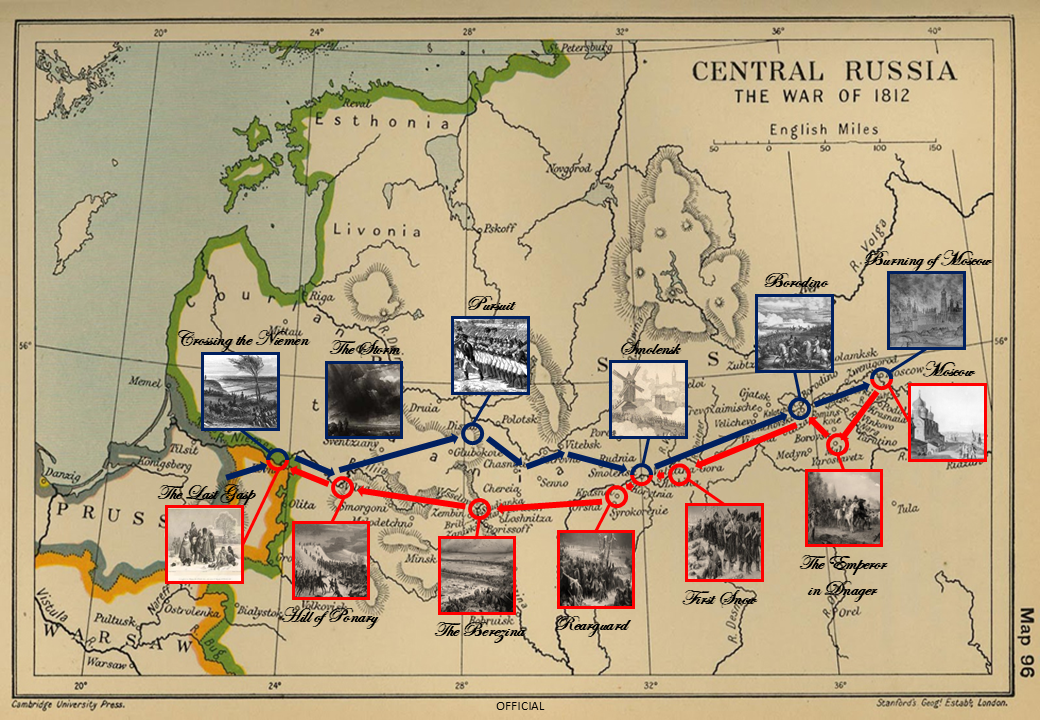
This campaign follows Capitaine Dumont as he leads his company of voltigeurs through the Russian campaign of 1812, all the way to Moscow then retreating back through the snows of winter.
Outline Structure
The campaign works as a programmed campaign with the outcomes from each scenario influencing subsequent activity. There are general rules for handling casualties and carry over, and specific rules depending on the scenario for what may happen afterwards. In between scenarios there are interludes which present off-table decisions for the French.
There are two distinct chapters, first the march to Moscow, and second the retreat. In general during the first chapter the outcome of any individual skirmish will not alter the pace of advance. In essence Dumont and his company get pulled along by the rest of the army. In the second chapter during the retreat however, Dumont and his men must keep up with the retreat overcoming the challenges encountered. If they fall behind the problems faced will change, with the possibility of Dumont's campaign ending in capture (if for instance he fails to make it to the Berezina before the bridge is destroyed).
Forces
There is a force library which contains details of all the different units that are encountered during the campaign, and the individual officers met by Dumont, including those who my be either sworn enemies or pocket book friends.
Core French
The core of the French force is made up of the voltigeur company of the 1st battalion of the 13th Legere from Morand's division of I Corps commanded by Marshal Davout. This consists of:
- Capitaine Dumont (Status III leader).
- Lieutenant Duret (Status II leader).
- Sergeant Fournier (Status I leader).
- Sergeant Bassot (Status I leader).
- Cornet Peletier (Musician).
- 4 groups of light infantry skirmishers (32 figures in total).
- Madame Cholet the company cantiniere.
- The company wagon.
The French must keep track of the health and strength of all these units throughout the campaign. If any leader, including Dumont, is killed or captured while the rest of the force remains free, that leader may be replaced.
Other French
The French player will have other forces available for each scenario. These will be defined according to the scenario, including the possibility that the French player can choose additional support. Dumont may also acquire “pocket book” contacts as set out in Dawns and Departures which will be listed here. Details are captured in the force library.
Russian
Russian forces will be wholly defined by the scenario and do not need to kept track of. It is assumed that the French are encountering different units each time, although with the possibility of French leaders acquiring arch-enemies under the appropriate rules.
Rules
This section specifies rules for use during the campaign. In general, the French player should follow the rules set out in Dawns and Departures, along with the variations specified here.
Sequence of Play
This is a fairly rigid programmed campaign with limited opportunity for deviation from the pathway set out. The sequence of play is built on four basic steps.
1 Play a Scenario or Interlude
The entry point for the sequence of play is to complete a scenario or interlude (ie. a non-tabletop scenario). The campaign opens with Crossing the Niemen, and each subsequent cycle begins with the playing out of either a scenario or an interlude in play.
2 Move to the Next Stage
After each scenario the French player calculates the movement required to move to the next stage - either a scenario or an interlude. During the advance this is simple as the French keep pace with the rest of the army. However during the retreat the French player must assess how his progress matches that of the army more generally and make decision on the actions available to help him keep pace.
3 Calculate Attrition and Impacts
Once the French player has calculated the time spent moving, they should calculate the consequential impact on attrition, any straggling that results from accumulating attrition, and what happens to any stragglers. They should also update their records of the number of suppliers remaining, and any other records that remain. They are then ready to begin the next scenario or interlude.
Movement
During Step 2 of the sequence of play the French player begins by calculating the time elapsed to the next stage (scenario or interlude). During the advance the French don't have to track whether they arrive at the next stage on time, this takes place automatically.
During the Retreat
During the retreat it is not guaranteed that Dumont and his men will keep up with the retreating army. At each stage of the retreat the French must use the movement procedure outlined here to determine when they arrive at each scenario or interlude. The timing of their arrival may alter the scenario encountered on arrival at each stage. Throughout the retreat the French must monitor how far ahead or behind the expected arrival date for the next stage they are. Each retreat interlude will present options for that may result in the French either gaining or losing time (along with other potential consequences).
The French must use the mechanism here to decide whether they gain or lose time, and must note their actual arrival time at each stage. For each journey between stages the French must roll a d20 on the following table to determine whether they gain or lose time:
| d20 | Result |
|---|---|
| 1 | Gain 3 days |
| 2-3 | Gain 2 days |
| 4-6 | Gain 1 day |
| 7-14 | Arrive in the specified amount of time |
| 15-18 | Lose 1 day |
| 19 | Lose 2 days |
| 20 | Lose 3 days |
The roll is modified by the following cumulative factors:
| Factor | Modifier |
|---|---|
| Each item of loot carried | +1 |
| Each group of 8 stragglers protected | +1 |
| On half rations | +1 |
| No rations available | +1 |
Once the French have calculated the loss or gain of time before they reach the next stage, and before this is finalised, there are a number of actions the player can take to recover time, see the table below.
| Action | Result |
|---|---|
| Abandon stragglers | Gain one day, all stragglers (both from Dumont's company and others) are left behind and captured |
| Abandon wounded | Gain one day, all wounded are left behind and captured. |
| Abandon loot | Gain one day, but reduce loot balance to zero. |
| Abandon wagon | Gain one day, but must leave the wagon and abandon everything carried on it. |
| Pick up the pace | Gain one day, but add +20 to attrition. |
There are a number of milestones during the retreat where there is a final cutoff point by which the French must arrive.
Supply
Following the Dawns and Departures rules, the French consume 1 sack of supplies per day of the campaign. The availability of supplies must be monitored throughout and must be reassessed before each scenario or interlude using the timeline to calculate the elapsed time since the last campaign and assessing the impact on both the remaining stock of supplies and the attrition of the French forces. during the retreat the French must also provide supplies to any groups of stragglers they are protecting, who will consume 1 sack for every 4 groups being protected. The French do not need to supply any additional support which may join the force for any individual scenario.
The French will be given an initial allocation of supplies at the start of the campaign. Each interlude (and some scenarios) will give the French opportunities to gather additional supplies. The troops themselves can carry 5 sacks of supplies between them. Any more must be carried by a wagon.
During Step 3 of the sequence of play, ie. in between stages, the French must calculate the time elapsed to the next stage and the sacks of supplies required to support both the core force and any stragglers they are supporting and deduct that number from their remaining store of supplies. If they do not possess sufficient sacks to cover their need they must calculate the consequential impact under the Attrition section. The French player may choose to consume at half the ration rate (ie. one sack every other day) at the consequence of an increased rate of attrition.
Additional supplies may be obtained at the interludes either by distribution from stores or by the actions of Dumont. It may also be possible to gain supplies during a scenario. The notes for both interludes and scenarios will specify the procedure in each case.
Attrition
The French must keep a record of their attrition count, adding increments as defined in the table below. every time the count reaches a multiple of 10 the French player must remove one figure from the core force and count them as a straggler. Stragglers cannot be used as part of the fighting force.
| Action | Impact on attrition |
|---|---|
| One day of marching on full rations | +1 |
| One day of marching half rations | +2 |
| One day of marching on no rations | +10 |
Scenarios and Interludes will offer opportunities to reduce the attrition count, and may also increase attrition by defined amounts depending on the outcomes specified by the scenario.
Stragglers
Stragglers are soldiers who have fallen behind the pace and no longer form part of an organised military unit, and cannot therefore be used as a fighting force. During the advance the French must keep a record of the number of figures from the core part of their force who are stragglers. They won't appear on the table as part of the French force, and represent simply a loss of resources. Interludes and Scenarios may offer the opportunity for stragglers to be recovered and reintegrated into the fighting force. Where an outcome specifies that a set number of stragglers are recovered these are figures that can be added back into the core fighting force, up to the limit of the actual number of stragglers.
During the retreat protecting stragglers is one core measure of success for Dumont. Stragglers seeking protection with the French captain's unit will come either from attrition from within Dumont's own ranks or be identified during interludes. Stragglers are grouped into groups of 8 and appear on the table during retreat scenarios without leaders.
On the table stragglers follow the rules for units suffering from excess shock. They react to treasure as 'militia' according to the standard Sharp Practice rules, and scenarios will specify where treasure is located on the table (for example in abandoned wagons along the route of retreat). Stragglers on the table can be activated by a leader in the normal way but cannot be commanded to fight or move towards the enemy. For each retreat scenario there will be an identified 'exit' point on the table, and for the stragglers to continue being protected by Dumont they must reach the exit point and 'jump off' together with the main force.
Loot
There will be a number of opportunities to acquire items of loot in both tabletop scenarios and interludes. These items both take up space on the wagon and slow Dumont and his men down (see the section on movement). Each item of loot can be treated as one purse for the purposes of career advancement in accordance with the rules in Dawns and Departures. Any loot that Dumont is still carrying at the end of the campaign should he finally make it back across the Niemen will be part of the final victory calculation. Should Dumont be captured at any point then any loot he is carrying may allow him to influence the outcome.
The Wagon
Dumont and company start with one wagon, and they may have the opportunity to acquire more during the campaign. During the advance wagon(s) don't need to appear on the table. However during the retreat every wagon must appear on the table and is therefore subject to capture by the Russians during a scenario.
Each wagon available to Dumont has a maximum capacity of 25 slots. Each slot can carry either one sack of supplies, one wounded man, or one item of loot.
Interludes
Interludes over Dumont a choice, usually outside of battle, to pursue one of a range of goals that may influence his future ability to survive the campaign. Ordinarily each interlude will present four separate pathways from which Dumont must choose which to take:
- Glory - seek to increase his reputation in the army.
- Resources - search for supplies and resources to keep the company fed.
- Wealth - go in search of treasure and loot.
- Men - look after his wounded and stragglers.
Each pathway will offer a range of possible outcomes, including negative ones.
Capture
There are two circumstances in which Dumont may be captured, either as a result of defeat on the tabletop, or as a result of failing to reach a key milestone on time. In either circumstance, Dumont may use any loot that he is carrying to influence the outcome. There is a small chance that Dumont may escape and return to the retreating French forces, in which case play resumes at the next scenario with any remaining men from the original company who were not captured, plus a new force created at the discretion of the player. If Dumont does not escape, then the campaign ends and these rules determine the final outcome.
Campaign Timeline
The timeline for the campaign is set out below. During the advance Dumont and his company simply maintain their position with the main army. After leaving Moscow however and throughout the retreat the French must monitor their progress against the timeline of the rest of the army. Each scenario and interlude outcome will determine whether Dumont's men gain or lose time. There are a number of key points identified on the timeline where Dumont must be at a particular place in time to be able to survive (eg. crossing the Berezina before the bridge is destroyed). The overall timeline for the campaign is set out in the table below:
| Date | Campaign Position | Milestone |
|---|---|---|
| 23 June | Crossing of the Niemen begins. | |
| 29 June | The storm. | |
| July | Foraging or a rearguard action. | |
| 17 August | Battle of Smolensk. | |
| 5 September | Assault on the Schevardino redoubt. | |
| 7 September | Battle of Borodino. | |
| 14 September | The army arrives at Moscow. | |
| 21 September | Marauding activity south of Moscow. | |
| 18 October | The Russian attack on Murat south of Moscow. | |
| 19 October | The army begins leaving Moscow. | |
| 23 October | The last units leave Moscow. | ✔ |
| 24 October | Battle of Maloyaroslavets. | |
| 25 October | Napoleon is endangered. | |
| 4 November | The first snow falls. | |
| 9 November | Return to Smolensk. | |
| 12 November | The army begins leaving Smolensk. | |
| 16 November | Battle of Krasny. | |
| 17 November | Ney and the last units leave Smolensk. | ✔ |
| 18 November | Ney fails to break through the Russians at Krasny. | |
| 19 November | Ney escapes across country and arrives at Orsha. | ✔ |
| 26 November | The first troops ford the Berezina at Studianka. | |
| 28 November | The last troops cross the Berezina and the bridges are fired. | ✔ |
| 5 December | Napoleon deserts the army. | |
| 9 December | The army arrives at Vilna. | |
| 10 December | The army leaves Vilna and struggles up Ponary Hill. | ✔ |
| 13 December | The army arrives at Kovno. | ✔ |
Scenarios
The Advance
The campaign opens with Dumont leading his men across the Niemen in boats, protecting the pontoneers whose job it is to prepare for building the pontoon bridges that will allow the rest of the army to cross. As the army approaches Vilna a huge storm sweeps in, and at the first interlude the French player must choose what to do as the storm hits influenced by whether they successfully completed the crossing of the Niemen.
As the army pursues the Russians towards the Drissa camp, depending on how Dumont and his company emerge from the storm they will then be faced with either an encounter with part of the Russian rear guard, or with the need to gather supplies from a village defended by the locals.
Arriving at Smolensk Dumont and his men are part of the assault on the southern side of the town, tasked with taking control of a cemetery. There is a second interlude in Smolensk where Dumont can choose to gather supplies and look after his wounded.
The pursuit continues beyond Smolensk until the Russians take a defensive position at Borodino. On the day before the main battle, Dumont and his company are involved in the assault on the Schevardino redoubt. Dumont must then decide what he and his company do during the battle of Borodino and assess the outcome.
Arriving at Moscow, the final interlude of the advance involves Dumont caught in the fires raging around the city.
| Name | Type | Date | Days from Previous | Assess Victory? |
|---|---|---|---|---|
| Crossing the Niemen | Scenario | 23 June 1812 | 0 | |
| The Storm | Interlude | 29 June 1812 | 6 | |
| Pursuit | Scenario | 17 July 1812 | 18 | |
| The Battle of Smolensk | Scenario | 17 August 1812 | 31 | |
| In Smolensk | Interlude | 18 August 1812 | 1 | Yes |
| The Assault on Schevardino | Scenario | 5 September 1812 | 19 | |
| Borodino | Interlude | 7 September 1812 | 2 | |
| Moscow in Flames | Interlude | 17 September 1812 | 10 | Yes |
| Total | 87 |
The Retreat
As the retreat begins Dumont and his men are marching along the Kaluga road mixed in with the baggage trains when in the early morning they witness Napoleon with just his staff around him attacked and nearly captured by cossacks. Will they be able to drive the cossacks off and save their emperor?
Turning away after the battle of Maloyaroslavets the army begins the march back to Smolensk and in early November the first snows begin to fall and Dumont must keep his men safe from the cossacks who start picking at the edge of the retreating column. After re-crossing the battlefield of Borodino they arrive back at Smolensk and, provided he arrives with at least a day to spare, Dumont has an opportunity to prepare for the next stage of the retreat.
In the first milestone, Dumont and his men must leave Smolensk by 17 November at the latest. If Dumont leaves Smolensk by 15 November then the rearguard scenario sees Dumont and his men pass through Krasny with the main army. If Dumont doesn't leave until 16 or 17 November Dumont must escape with Marshal Ney and the rearguard.
The retreat then reaches the Berezina. If Dumont arrives by 26 November the scenario sees him first across carried on the backs of some chasseurs' horses to secure the west bank and allow the engineers to build the bridges. Later and he must join the defence of Studianka. The last crossing is on 28 November after which the bridges are blown and Dumont and his men will be captured if they have not crossed by then.
Dumont then returns to Vilna where an interlude sees him and his men join the evacuation of the city and struggle to make it up the hill of Ponary.
Finally at the last gasp as they approach Kovno and the Niemen, Dumont must hold off the cossacks swarming around the rear of the last few survivors, and must reach Kovno by 13 December.
| Retreat Stage | Type | Milestone | Expected Date | Milestone Cutoff Date | Days from Previous | Assess Victory? |
|---|---|---|---|---|---|---|
| Departure from Moscow | Milestone | ✔ | 19 October 1812 | 23 October 1812 | 0 | |
| The Emperor is Threatened! | Scenario | 25 October 1812 | 6 | |||
| The First Snows | Scenario | 6 November 1812 | 12 | |||
| Return to Smolensk | Interlude | 9 November 1812 | 3 | Yes | ||
| Departure from Smolensk | Milestone | ✔ | 12 November 1812 | 17 November 1812 | 3 to 8 | |
| Rearguard | Scenario | 16 to 18 November 1812 | Varies | |||
| The Berezina | Scenario | 26 November 1812 | Varies | |||
| The Last Crossing | Milestone | ✔ | 28 November 1812 | Varies | ||
| The Hill of Ponary | Interlude | 10 December 1812 | Varies | |||
| The Last Gasp | Scenario | 11 December 1812 | Varies | |||
| Kovno | Milestone | ✔ | 13 December 1812 | Varies | Yes |
Victory
There are a number of points throughout the campaign where Dumont's victory progress is assessed. These are marked as such in the advance and retreat tables. In accordance with the “Reputation, Influence & Interest” rules in Dawns and Departures, the victory conditions for each tabletop scenario will specify the number of points available for Dumont to win. The other 'campaign outcome' points available in Dawns and Departures should also be assessed separately at each progress point.
Interludes work slightly differently. Dumont will be presented with a choice of which path to pursue from the four options of Glory, Resources, Men, and Wealth. From these, the Glory path will offer Dumont the opportunity to both gain additional victory points and even potentially to immediately gain a reputation level.
At each victory assessment, any change in Dumont's reputation is assessed according to the Dawns and Departures rules and his points total is returned to zero.
Should Dumont make it back across the Niemen at the end of the campaign he can complete a fifth and final assessment on reaching Danzig with any survivors. The following additional points are available:
| Outcome | Additional Points |
|---|---|
| For each 8 stragglers (or fraction thereof) that recross the Niemen | +1 point |
| For each 6 voltigeur (or fraction thereof) that recross the Niemen with the colours | +1 point |
Characters
- Capitaine Dumont the company commander.
- Madam Cholet the company's cantiniere.
Campaign Journal
Dumont's progress is recorded in the campaign journal.
Research
- Austin, Paul Britten 1812 Napoleon's Invasion of Russia (Greenhill Books, London, 2000)
- Tolstoy, Leo War and Peace (Penguin Classics, London, 2007)